Encyclopedia of Erotic Literature
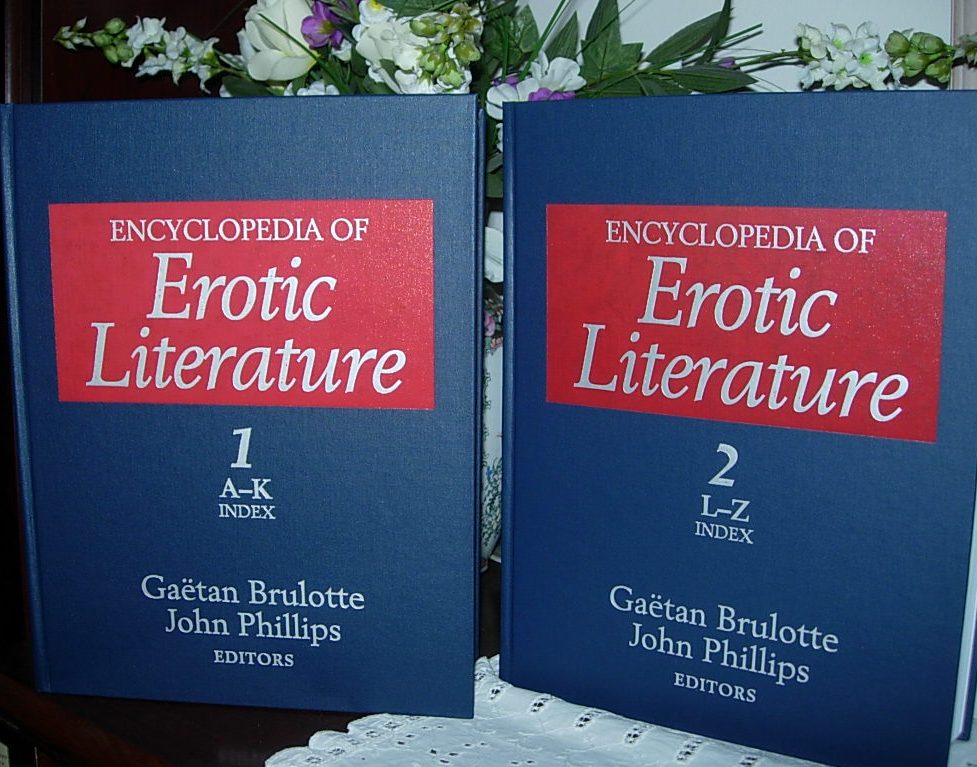
With its 2 volumes, 1,758 pages, 540+ entries, and six years of work with over 200 contributors and the best scholars and advisers in the field from all over the globe and from diverse universities such as Oxford, Cambridge, London, Harvard, Yale, Princeton, and Berkeley, this reference work is the very first of its kind and should prove a valuable research tool in the Humanities. Mainly aimed at libraries market, it is currently distributed all over the world. Neither a bibliographical listing nor an anthology of extracts from a limited number of texts, this encyclopedia is a comprehensive and discursive description and analysis of those innumerable works, written in many different languages throughout our known history, in which ‘sex-talk’ is the dominant discourse. The history of this literature is 4000 years old, i.e. almost as old as the history of writing itself.
Coverage
The work covers all representations of the erotic in literature since the ancients up to the present in all countries and continents, and in whatever language in which such literature has been produced. It includes all literary traditions and genres (narratives, poetry, essays, drama, sex manuals, etc)
Organization
Entries range in length from 1000 to 8000 words according to their importance. A-Z essays consisting of historical overviews, general topics and themes including critical approaches, literary surveys, writers and works. Each entry is accompanied by Further Reading, and, in the case of author entries, Selected Works. The Encyclopedia is fully cross-referenced with a comprehensive index.
Examples of article titles under each major conceptual heading of the book
- Historical overviews articles : covering the history of erotic literature in different countries and/or languages, and in different centuries, for example, Arabic from the Middle Ages to 19th century, French 19thC, English UK 18th C, Haitian Literature, French Canadian Literature, Persian Literature, Irish Literature, Czech Literature, French Women Writers. Greek Ancient Verse, Russian Literature, Gay (Male) Writing…
- General topics and themes, including sociological issues and critical approaches: eg, hermaphroditism, jouissance, libertinism, grisettes, religion, libraries, feminism, queer theory, positions, breast, bestiality.
- Literary Surveys : covering a peculiar literary genre or form of expression, such as Latin American short stories, Chinese sex manuals, slash fiction, jests, yaoi, drama…
- Writers and Works : individual entries on important authors/works (entries on individuals contain a brief biography as well as a list of works and further reading)
- Examples of featured writers: Saikaku, Bataille, Nabokov, Joyce, Nin, Miller, Sade, Millet, Sollers, Laclos, Colette, Ernaux, Labé, Crébillon, Djebar, Apollinaire, Brantôme, Depestre, Gombrowicz, Jong, Jelinek, Vallejo, Kawabata, Reich , Al-Nafzawi, Obayd-e Zakani, Updike, Shakespeare, Aretino, Bright, Ovid, Theotokis, Valdés, D.H. Lawrence.
- Examples of anonymous works: Kamasutra, Jin Ping Mei, The Jades Pavilion, Book of Odes, Letters of a Portuguese Nun, The Private Case, Fanny Hill…
Point of View
The point of view aims to be as objective as possible. Entries tend to be descriptive and analytical, eschewing any form of judgmentalism, whether political or moral . Generally speaking, however, the aim is to present this literature in a positive light, revealing its enormous variety and complexity, and where appropriate, drawing attention to the considerable merits (literary, social, historical and otherwise) of a hitherto despised genre.
What makes it unique?
There is no other work of its kind in existence in the English language. Most existing reference works are anthologies with short presentations of excerpts. This is an encyclopedia in the strict sense of the word, giving comprehensive information on erotic literature in all major languages and throughout human history.
Any important relationship between material found in this book and current events or concerns?
20th century French essayist Georges Bataille established that sexuality was the major problem of mankind, and no one else made it such than ourselves. As a significant cultural phenomenon, sexuality and its literary representation have become an emerging area of study in the Humanities over the last one hundred years, from Freud to Barthes and Foucault and beyond. This reference work comes in the path of that research trend and relates to current events or concerns, such as:
1) The world-wide development of New Historicism which is revisiting history, including the history of literature (with its mechanisms of inclusion and exclusion), and the history of mentalities and of such notions as love and intimacy as they have evolved throughout the centuries (this interest is testified to by recent publishing successes such as the history of beauty and the history of the body in France and Italy).
2) Our encyclopedia also relates to ongoing debates about censorship, cultural differences in the area of sexuality and the representation of sex in literature, as well as to the postmodern movement away from fixed eternal verities to relativity and plurality in the field of ideas and the perception of behaviors.
3) The interest of scholars for this literature was arisen by three master minds of our time who transformed our way of thinking.
A) Foucault recommended paying special attention to minor or forgotten texts, those who were excluded from history, as these texts may shed new light on our reality. He would welcome defiant thinking, integrate error to mainstream for its illuminating influence, and look at what creates special problems to human consciousness as being of particular interest, and no doubt sexuality does. Hence the temptation for us to go through the back door of history into its margins and in the underground world to look at hidden treasures.
B) Deleuze, for his part, taught us the value and inner dynamics of what he calls “minor literatures”, i.e. small literatures produced by restricted groups and set in the margins of History, such as Quebec literature: and small literatures are part of our encyclopedia, which constitutes an additional original feature.
C) Finally, Roland Barthes has enormously contributed to integrate this literature into main stream research with his daring studies of Sade, for instance. He accepted from 1974 to 1978 to be Gaetan's dissertation director on this very subject, erotic literature, and he became his mentor, after he had the invaluable chance to work closely with him just before his accidental death.
These thinkers have in common a critical attitude of openness and inclusion, rather than exclusion, they have encouraged us to develop an open mind, as an open mind is like an open window in winter, it lets the fresh air in.The inspiring attitude that these models have embraced could be wonderfully summarized with this quote by Russian critic Mikhail Bakhtine: "Creative understanding continues creativity, and multiplies the artistic wealth of humanity."
We certainly hope that this attitude also transpires from this reference work, which seeks to bring this corpus into new light
What the critics have said about this reference work?
"Admirably serious", "The Encyclopedia of Erotic Literature takes one into some relatively unfamiliar sexual territories -Japanese, Chinese, Arab, Zulu, Thai and Catalan. (...) This is an exceedingly serious work of reference and, despite the occasional burst of postmodern pretension, the general quality of the entries is high. The thematic subjects have been intelligently chosen." R. Irwin, Times Literary Supplement (London, Feb. 8, 2008).
"Finally, the first world encyclopedia of erotic literature is coming; for those who love the subject and want to know all about it. Six years' work, 540 entries, 400 contributors, 20 consultants from the best universities from around the world. The result: The Encyclopedia of Erotic Literature (Routledge, 350$), the first "Who's Who" entirely dedicated to sex in literature." Babcok, Mila Esther. "Variazioni Poetiche." Gentleman Quarterly - Italy.
Feb. 2007, p. 267. English translation from the Italian by Adele Bennett.
"It's hard to believe this has never been done, but here it is, six years in the making, with 546 entries from 400 contributors, covering erotica from every nook and cranny of the world. The delight of the two-volume masterwork is not in the usual suspects but entries such as those on linguist Gershon Legman (master of the dirty joke), the use of furniture in erotic fiction (the money shot is its collapse) and Charles Fourier, who before his death in 1837 predicted that orgies would someday consist of sex combined with art -- an idea so radical it was kept out of print until 1966. The volumes make for great bedtime reading, but they are heavy, so you'll need both hands." Chip Rowe, Playboy Internet, posted since July 2008.
"The 546 entries are the work of over 400 scholars. The introduction attempts to seek clarity in the debate between what constitutes the erotic, the pornographic, and the obscene. In the end, the editors opt sensibly for an approach that includes any work in which ‘sex talk’ is the dominant discourse. There are four categories of entry: (a) individual listings for writers and for some single works; (b) historical overviews (by language, geography, or cultural area); (c) literary surveys (e.g. addressing genres); and (d) topics and themes (e.g. necrophilia). A 104-oage index is a sophisticated navigation tool, and two tables of contents, alphabetical and thematic, are printed helpfully, like the index in each volume.
Some of the best author entries are honed to focus specifically on the erotic contributions of writers of wider sweep, such as the essay on Apollinaire with its satisfying mix of example and analysis, and the entry on Edith Wharton, devoted to the incest theme in Beatrice Pamlato. An unsolemn, fun-loving text on Philip Roth reminds us of the mayhem created by Portnoy’s Complaint and its sequel. The entry on Jean Lorrain is unsparing but fair.
Even more stimulating contributions address not individuals but specific subject areas. Joseph Slade III creates an irreplaceable research tool in his essay on library collections. Alongside references to the Private Case (which has its own entry) of the British Library and the holdings of the Kinsey Institute, Slade cites dozens of bibliographies and lesser-known collections, such as the 31,500 works related to gays and lesbians in Brown University’s Katzoff Collection. An entry on Furniture charts the movement of sexual trysts from sofa and divan to the modern-day bed. The canon receives ample treatment, but more edgy topics and authors receive their due, viz. the entry on mangas, yaoi, slash fiction, Kathy Acker, Ludia Lunch. There are 48 entries on Spanish-language authors and topics, 10 on German subjects, over 25 on Chinese literature, and 14 on Japanese, plus useful overviews of Japanese erotic writing covering medieval times to the twenty-first century.
Scores of factoids emerge. Who knew that the best-known author of German erotic literature, Felix Salten, wrote the Bambi story used in Walt Disney’s film, or that Ben Franklin penned a raunchy letter of advice on choosing a mistress in which he counselled bedding older women? One also encounters amusing eccentricities (…)”
Michael R. Finn, Modern Language Review 103.3 (July 2008): 820-821.
“Editors Brulotte and Philipps (…) remark than many of the 546 signed scholarly essays –written by university professors and independent researchers from around the world- relate to literature in French because French writers have contributed most to the erotic genre. (…) Geared toward a sophisticated audience, this work, while accessible, is most appropriate for scholars. Recommended for academic libraries.” Jennifer L. Lack. U.S. News and World Report (Washington, DC). Repr. In Library Journal, fév 2007, 147-148. www.libraryjournal.com
“With the Encyclopedia of Erotic Literature (2006, 1579584411, $350) Routledge has published a serious, scholarly work that focuses on an absorbing topic that has been neglected in the reference literature. Edited by Gaetan Brulotte and John Phillips, these two volumes contain more than 500 signed articles authored by some 400 contributors. The essays range from shorter entries of 1,000 words to expansive articles of 8,000 words. While the arrangement is alphabetical, the editors divide the articles into four broad categories; historical overviews, topics and themes, literary surveys and writers and works. And to reinforce and supplement this overall “conceptual framework,” they provide a thematic table of contents that gives the reader additional breakdowns by country and language. (…) Overall, the articles in this set are impressive. They are thoughtful and well researched and a number having substantial bibliographies. The Encyclopedia of Erotic Literature merits addition to serious literature collections. It provides information on specific topics, as well as conveys the fact that erotic literature spans multiple cultures and eras. With this work, editors Brulotte and Phillips provide a rich and necessary academic reference for interested students and scholars.” Gilson, Thomas (2007) "From the Reference Desk," Against the Grain: Vol. 19: Iss. 2, Article 26. DOI:https://doi.org/10.7771/2380-176X.5066 This document has been made available through Purdue e-Pubs, a service of the Purdue University Libraries. Please contact epubs@purdue.edu for additional informationSome links to know more about it:
Link to Feb 14, 2008 G. Brulotte's lecture on Encyclopedia of Erotic Literature. Watch it in full, one hour.
Times Literary Supplement ( London ) review web link by R. Irwin (Feb 8, 2008): click here to read article
Response in TLS by G. Brulotte and J. Phillips, Feb 22, 2008: click here to read editors' response
Link to John Phillips' interview at London Metropolitan University, March 2008
Publisher's web site http://www.routledge-ny.com/